FREE CATALOG



Custom Button Up Flannel Shirt: The Complete Sourcing Guide for Brands and Buyers
- Addtime: 2026-11-25 / View: 12
Why a Custom Button Up Flannel Shirt Belongs in Every Collection
Flannel never really left the market — it simply moved from lumberjack stereotype to wardrobe staple. Today it sits comfortably in streetwear drops, workwear capsules, outdoor programs, holiday gift guides, and corporate uniform lines at the same time. That versatility is exactly why a custom button up flannel shirt has become one of the most requested private label items for small and mid-sized apparel brands.
Off-the-shelf flannel has a ceiling. Every competitor can buy the same plaid from the same wholesaler and sell it at the same price. A custom button up flannel shirt lets you control the three things shoppers judge in the first ten seconds: plaid scale, fabric hand-feel, and fit across the shoulders and chest. Get those right and your product stops competing on price.
Fabric, Fit, and Silhouette: Where the Product Is Won
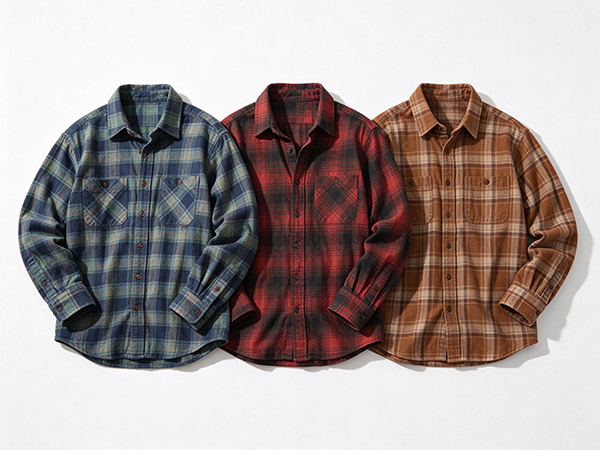
Flannel is a weave, not a fiber. The soft, brushed surface comes from napping the fabric after weaving, which raises fine fibers and creates that characteristic fuzzy hand-feel. The fiber underneath determines weight, warmth, durability, and price.
Cotton flannel remains the default for most programs. A 100% cotton shirt in the 5–6 oz range works for year-round retail in most climates, washes well, and holds plaid definition sharply. Heavier 7–8 oz cotton reads as a true cold-weather shirt and pairs naturally with the overshirt trend. Cotton-poly blends lower cost and reduce shrinkage, but the nap can pill faster after repeated washing, so test pilling before approving bulk if you go that route. Recycled and BCI cotton are increasingly requested by European and North American buyers who need documented fiber sourcing.
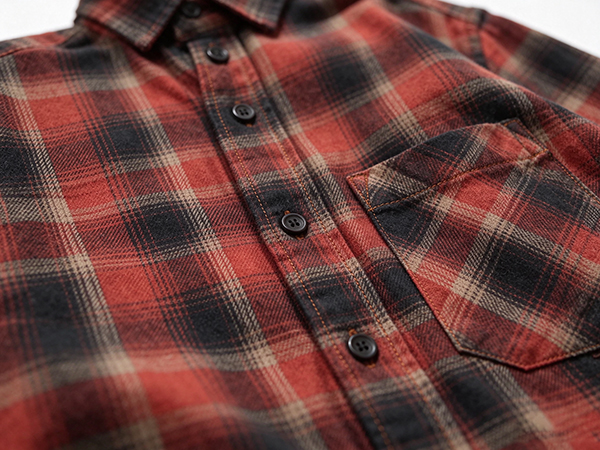
Plaid direction matters as much as weight. Yarn-dyed plaids hold color better than prints and are standard for premium programs; prints are cheaper and allow unlimited colorways at lower minimums. Check plaid matching at the front placket, side seams, chest pocket, and sleeve caps, because misaligned plaid is the fastest way to make an expensive shirt look cheap.
Once the fabric is settled, the pattern decides whether the shirt sells. A custom button up flannel shirt wins or loses on the block, and three silhouettes cover most of the market. Classic fit keeps a straight body and a generous armhole, worn tucked or untucked, which makes it the safest choice for wholesale and uniform programs where you cannot measure every end user. Regular-tapered fit nips the waist slightly, cleans up the armhole and shortens the body, the volume silhouette for DTC brands selling to 25–40 year olds. Oversized or boxy fit drops the shoulder, lengthens the body and widens the sleeve, which suits streetwear, unisex lines and shacket styling.
Two measurements do the heaviest lifting: shoulder width and chest circumference. A 1 cm shoulder change alters the perception of the whole garment, while chest ease decides whether the shirt layers over a tee. For overshirts, add 8–12 cm of ease over the body measurement; for a classic tucked shirt, 6–8 cm is enough.
Size grading deserves its own conversation. Selling into the US? Build from a documented size chart with consistent increments and publish garment measurements, not body measurements. Selling into the EU? Expect more tapered blocks and longer bodies. Shipping to the Gulf? Verify sleeve and body length against local preference before you cut, since a US medium often reads short in Dubai or Riyadh.
Construction and Customization: Building a Precise Tech Pack
Buyers rarely list construction in a brief, then complain about it after delivery, so lock these details down in your tech pack. Stitch density should sit at 12–14 stitches per inch on side seams and armholes, because loose stitching is the first thing a returns inspector notices. The placket needs to be two-piece with clean topstitching so it holds shape after washing, while a single layer will curl at the edges. A double-layer back yoke hides the shoulder seam and stabilizes drape, the chest pocket should carry matched plaid and reinforced bar tacks, and buttons should be 4-hole corozo or resin in a matched colorway, since cheap two-hole buttons undermine an otherwise premium shirt. A lightweight fusible interlining in the collar stand and cuffs keeps the collar standing after ten washes. Wash the pre-production sample three times before approval: 3% shrinkage is normal on cotton flannel, so adjust the pattern or pre-shrink the fabric if it exceeds your tolerance.
The word "custom" scales, and most programs land between light branding and full private label, so knowing the ladder helps you budget. Light branding means a woven main label, printed care label, size tags, and a hangtag with your logo. It carries low cost, low MOQ and fast turnaround, which makes it ideal for testing a new plaid.
Mid-level private label moves further: plaid developed to your Pantone references, your own button color, an embroidered logo on the pocket or cuff, and branded polybag and carton marking with your SKU codes. Full private label covers a custom pattern block, exclusive yarn-dyed plaid, branded buttons, custom collar shape, woven hem tag, retail-ready packaging, and factory-applied barcode labels.
Embroidery is the most cost-effective branding upgrade. A 3–4 cm chest or cuff logo carries a modest upcharge and reads as intentional design rather than decoration. Screen print on flannel is less reliable because the brushed surface absorbs ink unevenly.
MOQ, Sampling, Quality Control, and Compliance
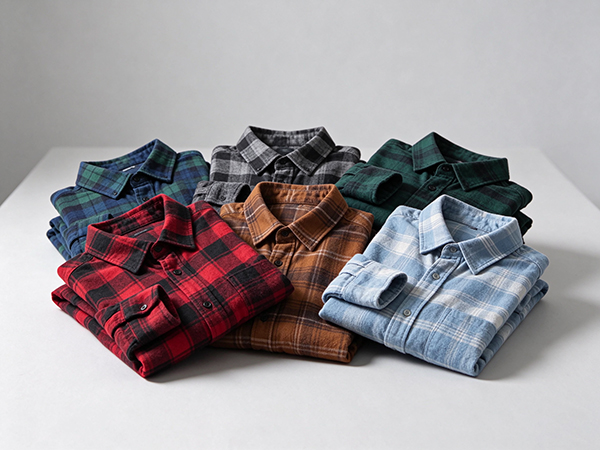
Minimum order quantities depend on whether the plaid is stock or developed. Stock plaid on a stock pattern carries the lowest MOQ, often 100–300 pieces per colorway. A stock plaid cut to a new pattern generally lands at 300–500 pieces. Custom yarn-dyed plaid sits at the top, often 500–1,000 pieces per colorway plus a substantial sampling fee, because the mill has to warp and weave a dedicated run rather than pull from existing greige.
Timelines follow the same logic. A stock-fabric program can move from approved sample to shipment in 25–40 days, while a custom plaid adds 20–35 days for weaving and lab dips before cutting even starts. Build your launch calendar backwards from the delivery date, not forwards from the order date. Sampling runs in three stages: lab dip and swatch approval, fit sample (one size, correct fabric), and pre-production sample (full size set with labels and packaging). Approve each stage in writing with dated comments, because verbal approvals are the most common cause of bulk disputes.
Quality control comes next, and it belongs at the factory rather than your warehouse. Run an AQL inspection before goods leave. Measure 5–10 pieces per size against the approved spec with a ±1 cm tolerance on body measurements, and check plaid matching at the front placket, side seams, chest pocket and sleeve caps. Stitching should show consistent density, intact seams, no skipped stitches and no loose thread tails, while collar points, cuffs, pocket placement and hem level should be symmetrical on both sides. Confirm there is no shade variation between panels or within a lot, that buttons are firmly attached, that labels sit in the right place, and that no sharp or loose hardware ships.
A three-wash test on a sample set is worth the extra week, and the final carton check covers polybag, size assortment, carton ratio and a barcode scan. Document every defect with photos and count. A factory that argues with photo evidence will argue with your next order too.
Compliance and logistics close the loop. For the US, adult flannel falls under fiber content and labeling rules rather than children’s testing; only kids’ sizes need a Children’s Product Certificate. For the EU, plan for REACH compliance, fiber labeling in local languages, and ISO care symbols. Flammability testing may be requested in some markets, so confirm with your buyer before production.
Flannel is bulky and compresses less than a knit, so carton dimensions and piece counts directly affect freight cost. Confirm carton specs, gross weight, and HS classification with your forwarder early, because a wrong HS code can stall a shipment for weeks.
Buyer FAQ
1.What is the minimum order for a custom button up flannel shirt?
It depends on the fabric. Stock plaids and patterns usually start around 50 pieces per colorway, while custom yarn-dyed plaids typically require 200–300 pieces.
2.How long does production take?
Stock fabric and stock pattern run 20-40 days after sample approval. Custom plaid adds 10-20 days for weaving and lab dips before cutting.
3.Can I use my own plaid design?
Yes. Provide a Pantone reference or physical swatch, then request a lab dip and woven header before bulk. Approve both under daylight and store lighting.
4.Which fabric weight should I choose?
5–6 oz for year-round retail, 7–8 oz for cold-climate markets and overshirt styling, 4–5 oz for lightweight summer-friendly flannel.
5.Is flannel suitable for corporate uniforms?
Yes. Classic fit, a subtle plaid, an embroidered chest logo, and a documented size chart make one of the most reliable uniform programs, provided the plaid stays in stock for fast replenishment.